Let me be upfront about something. Trying to stay fit while traveling sounds great in theory — morning runs, hotel gym sessions, salads by the harbour. The reality? I spent three days in Hong Kong getting on the same bus, going to the same place I had just left, and calling it cardio.
True story. My friend and I were trying to get back to our hotel in Macau. We spotted a bus, jumped on it, rode it for 20 minutes, got off — and were standing in the exact same spot we started from. Twice. On the third try we finally figured out we had been taking a circular route the whole time.
By the time we got back to the hotel, we had walked so much that my fitness tracker congratulated me. So technically, I stayed fit. Just not in the way I planned.
Here is what I learned from Hong Kong, Macau, and a dozen other trips: staying fit while traveling is less about perfect workouts and more about building habits that survive chaos. This guide is everything that actually worked for me — and a few things that definitely did not.

Table of Contents
Why It Is So Hard to Stay Fit While Traveling
I am not going to pretend this is easy. If you have ever come home from a trip feeling softer and slower than when you left, you already know the drill.
Here is what actually happens when you travel:
- Your sleep goes sideways. New time zones, new beds, and the pressure of not wasting a single hour of your trip means you are chronically under-slept. Tired people do not work out. Tired people eat dim sum at midnight.
- Food is everywhere and it is incredible. You are in Hong Kong. You are not eating a salad. The egg tarts alone are worth the trip.
- Your routine disappears completely. No familiar gym, no usual schedule, no accountability partner. The structure that makes fitness automatic at home simply does not exist.
- Walking replaces training — but not consistently. Some days you walk 20,000 steps exploring. Other days you sit in a cable car for three hours because the view is too good to leave.
None of this makes you lazy. It makes you human. The goal is not perfection — it is building a few non-negotiable habits that keep you moving regardless of what the day throws at you.
10 Strategies to Stay Fit While Traveling (That Actually Worked for Me)
1. Pack Resistance Bands — Seriously, Just Do It
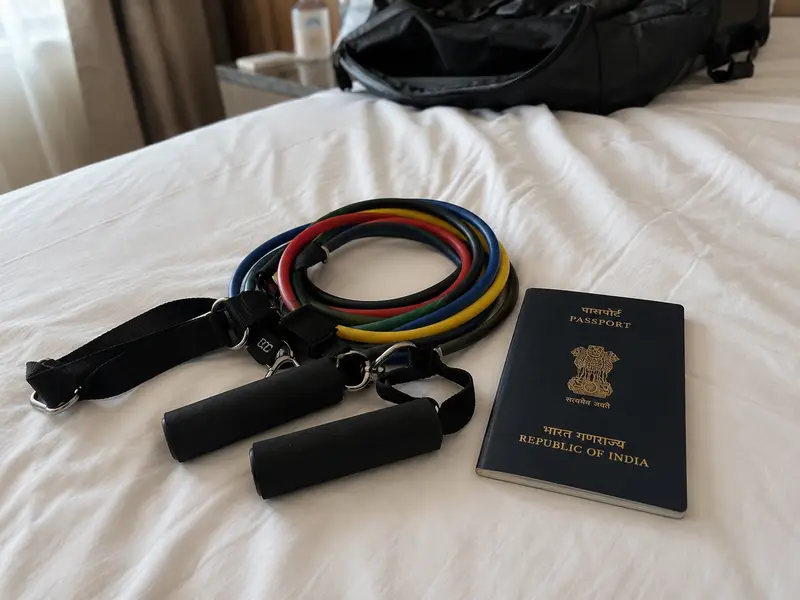
I resisted this for years. Bands felt like a compromise. A consolation prize for people who could not find a real gym. Then I packed a set for my Hong Kong trip and did a 25-minute workout in my hotel room at 7am before anyone else was awake.
I was genuinely sore for two days. These things work.
A set of resistance bands weighs under 200 grams and fits in a side pocket of any bag. With them you can train your chest, back, shoulders, arms, glutes, and legs — from any hotel room in the world. Squats, rows, hip thrusts, lateral walks, chest press — all possible, all effective.
💡 Tip: Buy a set with at least 3 resistance levels. The light band is great for warm-up and shoulder work. The heavy one will humble you. Total cost: under $20.
2. Do a 20-Minute Hotel Room Workout — No Excuses
You do not need a gym. You do not need equipment. You need 20 minutes and a floor. That is it.
Here is the exact circuit I used in Hong Kong when the hotel gym was — and I am being generous here — a single treadmill and a yoga mat from 2011:
- Push-ups — 15 reps
- Jump squats — 12 reps
- Reverse lunges — 10 each leg
- Mountain climbers — 30 seconds
- Plank hold — 45 seconds
- Burpees — 8 reps (I hate these, they work)
Three rounds. Rest 60 seconds between rounds. Done in 20 minutes. You will sweat, you will feel accomplished, and you can eat the egg tarts with zero guilt.
” The apps that helped me most: Nike Training Club (free, huge library, offline mode) and FitOn (guided workouts, zero equipment options). Download both before you travel.”
3. Walk Like You Are Getting Paid for It
The single best thing I did to stay fit while traveling in Hong Kong and Macau was walk everywhere. Not because I planned it — but because we kept getting lost.
Between the wrong train platforms and the circular bus situation, we probably walked 18,000 steps on our worst navigation day. My legs were tired but my conscience was clear.
In all seriousness — walking is the most underrated fitness tool in the world. A moderately active tourist clocks 12,000 to 18,000 steps per day without trying. That is 600 to 900 extra calories burned daily compared to sitting at a desk. Skip one Uber ride, walk to the restaurant, take the scenic route — it adds up fast.
💡 Tip: In Hong Kong specifically — take the tram on Hong Kong Island. It is slow, cheap, and covers so much ground on foot between stops that you end up walking more than you realise.
4. Check the Hotel Gym Before You Book — Not After
I have made this mistake more than once. You book a hotel, the listing says ‘fitness centre,’ you imagine a full rack of dumbbells and a cable machine. You arrive. It is a stationary bike from 2008 and a handwritten sign that says ‘gym.’
Before booking any hotel, Google the hotel name plus ‘gym photos’ and check TripAdvisor reviews filtered by the word ‘gym’. You will quickly discover whether it is worth your time or whether you should plan for room workouts from the start.
For my Macau hotel, I checked ahead and found out the gym was actually decent — free weights up to 20kg, a few machines, decent space. That intel changed how I packed. I brought fewer bands and a jump rope instead.
5. Work Out in the Morning or Accept That It Will Not Happen
This is the harshest truth about trying to stay fit while traveling: evenings are gone. By 7pm you are full from dinner, your feet hurt, and someone in the group has already suggested rooftop drinks with a view. You are not going to work out. And honestly, you should not feel bad about it.
Mornings are the only window that is truly yours on a trip. Before the itinerary starts, before the group chat fills up with plans, before decision fatigue sets in — your morning belongs to you.
I am not a natural morning person. But when I was in Hong Kong and set my alarm for 6:30am, I discovered something: the city at that hour is completely different. Quieter. Cooler. Street markets just opening. Old men doing tai chi in the park by the waterfront.
I did my workout, had my coffee, and was showered and ready before my travel companions were even awake. Best part of the day, every time.
Lay out your workout clothes the night before. Set your alarm across the room. Give yourself a 5-minute grace window — then start moving. The hardest part is always just beginning.
6. Eat Smart Without Becoming the Boring Person at the Table
Here is my rule abroad: eat the local food. All of it. Dim sum in Hong Kong, egg tarts in Macau, street noodles at midnight — yes to all of it. Life is short and the food is extraordinary.
But here is the thing — even within incredible local food, there are smarter choices. In Hong Kong, steamed dim sum is a completely different calorie equation than deep-fried dim sum. Wonton noodle soup is a far better lunch than a western-style burger from a hotel café. Congee with lean protein is one of the best post-workout meals you can find in any Hong Kong cha chaan teng.
The strategy is not restriction. It is anchoring. Every meal, anchor to a protein source first — roast goose, steamed fish, tofu, eggs, whatever is local and quality. Build the rest of the plate around that. You will feel full, fuel your workouts, and still eat everything the city has to offer.
- Start meals with soup or broth — reduces appetite naturally
- Choose steamed or wok-tossed over deep-fried where the choice is clear
- Eat slowly — travel meals eaten fast are meals you barely tasted
- Hydrate between drinks — one glass of water between every alcoholic drink
I did completely abandon this strategy on day 4 in Macau. The Portuguese egg tart situation got out of hand. No regrets.
7. Drink More Water Than You Think You Need
Dehydration is one of the most common reasons people feel sluggish and unable to stay fit while traveling — and it hits hardest in hot, humid cities like Hong Kong in summer. You are walking more than usual, sweating more than usual, and probably eating saltier food than usual. The combination destroys your water balance fast.
On a plane, the cabin air is 10–20% humidity — the equivalent of a mild desert. By the time you land after a long flight, you are already behind. Most people mistake this dehydration for hunger and reach for a snack when what they actually need is half a litre of water.
- Carry a refillable bottle through security and fill it at the gate
- Drink 500ml before boarding any flight
- Target 250ml per hour during long-haul flights
- In humid cities — add electrolyte tablets to your water (Nuun or LMNT)
- If you feel fatigued mid-day on a trip — drink water before assuming you need caffeine
That last point, though — sometimes you do need the caffeine.
8. Use Coffee Strategically — It Is Not Just a Morning Ritual
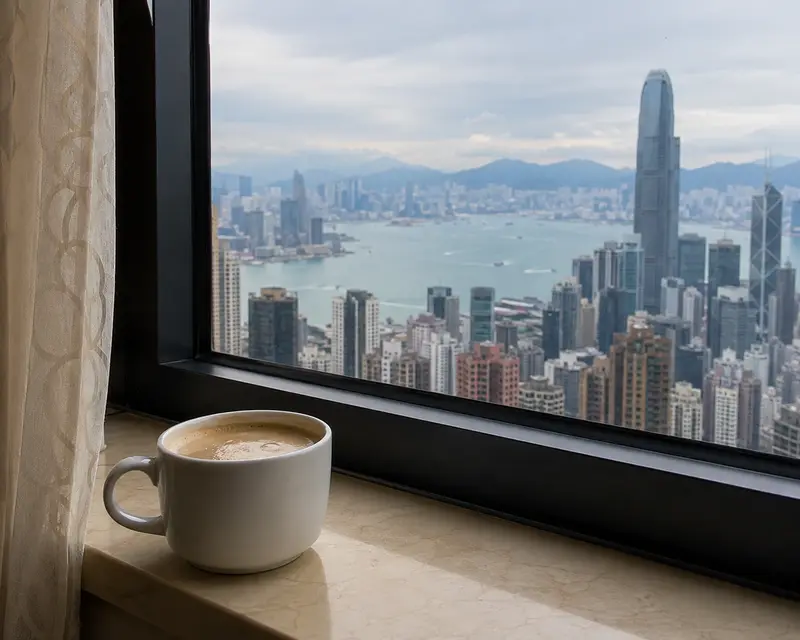
I drink coffee every day at home before my workouts. Travelling did not change that. In Hong Kong I was holding a cup of milk tea or black coffee from a cha chaan teng basically every morning before doing anything physical — whether that was a hotel workout, a long walk, or an unexpectedly vigorous exploration of a bus route.
This is not just habit. Caffeine is genuinely one of the most studied performance-enhancing compounds in sports science. Consumed 45–60 minutes before exercise it:
- Blocks adenosine — the chemical that makes you feel tired
- Increases adrenaline — primes your body for physical effort
- Sharpens focus — useful when you are trying to deadlift in a tiny hotel room
- Boosts fat burning by up to 29% during cardio
- Reduces how hard exercise feels — same effort, more output
If you want the full breakdown of doses, timing, and which coffee types work best for training, I wrote a complete guide: how coffee can improve workout performance. The short version: 1–2 cups, 45 minutes before, black or near-black, no sugar.
And if you travel with your own coffee setup — which I highly recommend — check out our guide to the best travel coffee mugs. A good insulated mug is non-negotiable for hotel room mornings.
💡 Tip: Hong Kong cha chaan teng coffee is strong, cheap, and genuinely excellent as a pre-workout. Order it black or with evaporated milk (still lower sugar than most café options). It became my favourite pre-workout ritual of the whole trip.
9. Treat Getting Lost as a Workout — Because It Is
I want to come back to my Hong Kong transportation saga for a moment, because I think there is an actual lesson buried in the embarrassment.
The day we could not figure out the MTR — the Mass Transit Railway — in Hong Kong, we spent probably 45 minutes walking between exits, checking maps, second-guessing platforms, and eventually just walking to where we needed to go. That is 45 minutes of low-intensity cardio that I definitely did not plan but absolutely got.
The bus incident in Macau — three loops of the same route — added another hour of walking once we finally gave up on public transport and used our legs instead. My step count that day was 21,000.
The honest truth about how to stay fit while traveling: sometimes the city does the work for you. Embrace the confusion. Walk to things instead of riding. Take the stairs in the MTR instead of the escalator (Hong Kong has some very long escalators). Get off one stop early. These micro-decisions accumulate into real fitness.
The best travel workout is often the one you did not plan. A wrong turn, a missed bus, a detour through a neighbourhood you did not know existed — these are not problems. They are bonus cardio.
10. Handle Long Flights Like a Professional Athlete
The flights to Hong Kong from most places are long. Really long. And sitting in a pressurised metal tube for 8 to 14 hours is genuinely one of the worst things you can do to your body if you do not manage it right.
What I do now on every long-haul flight:
- Aisle seat only. The extra 20 steps per hour you get from unobstructed access to the aisle adds up.
- Stand and walk every 90 minutes. Set a phone alarm. Do not wait until you feel stiff — prevent the stiffness.
- Compression socks. I resisted these for years. They genuinely make a difference — less swelling, fresher legs on arrival.
- No alcohol. I know. But alcohol on planes dehydrates you faster, fragments your sleep, and means you land feeling two days older than you should.
- Seated movement: ankle circles, leg raises, shoulder rolls, spine twists — every hour.
- Melatonin at destination bedtime. Not home bedtime. This single habit cuts jet lag recovery in half.
I ignored the alcohol advice on my first long-haul and arrived feeling like I had already been on the trip for three days. Never again.
The Days I Completely Skipped — And Why That Is Fine
Look, I am going to be honest with you. Not every day when you are trying to stay fit while traveling is going to have a workout in it. Some days you are going to walk through the Ruins of St Paul in Macau, eat a giant Portuguese meal, take a ferry back across the Pearl River Delta, and arrive at your hotel at 11pm with absolutely nothing left.
Those days happened to me. Several of them. And I did not work out. I slept.
The mistake most people make is treating a missed workout as a failure that requires punishment — over-restricting the next day, doing a punishing double session, spiralling into guilt. That approach does not work. It creates a miserable cycle that makes you resent both travel and fitness.
My rule: skip guilt-free when the day genuinely requires it. Walk more on those days if you can. Eat reasonably. Sleep properly. And be back at it the next morning. That is the whole strategy.
Consistency across a month matters infinitely more than perfection across a single trip. One week of imperfect fitness in Hong Kong will not undo six months of hard work at home. I promise.
A Sample Week of Travel Fitness (What Mine Actually Looked Like)
If you want a realistic template for how to stay fit while traveling on a 7-day trip, here is roughly what my week in Hong Kong and Macau looked like — not the ideal version, the actual version:
- Day 1: Long travel day, zero workout, walked the airport, slept on arrival. Ate whatever was available. Hydrated a lot.
- Day 2: 7am hotel room session — push-ups, squats, resistance bands, 25 minutes. Explored on foot. 16,000 steps total.
- Day 3: Skipped workout. The dim sum situation took over. 14,000 steps walking the city.
- Day 4: Morning workout, 20 minutes bodyweight only. Best hotel coffee of the trip. 18,000 steps.
- Day 5 (Macau): The bus incident. Accidental cardio day. Zero formal workout, 21,000 steps. The universe provided.
- Day 6: Full hotel gym session — they had decent free weights. Ate congee for breakfast like a local.
- Day 7: Easy morning walk along the waterfront before the flight home. One last cup of Hong Kong milk tea.
Not perfect. Very real. Net result: came home feeling fit, happy, and not like I had to undo a week of damage.
One More Thing: Drink Better Coffee When You Travel
A genuine way to stay fit while traveling is to make your morning coffee ritual count. Not just as caffeine — but as a moment to slow down, set your intention for the day, and fuel a workout or a long walk with something you actually enjoy drinking.
Hong Kong has extraordinary coffee culture. So does Macau, in its Portuguese way. Part of what made my mornings work was looking forward to that first cup — sitting with it, not rushing it, and then heading out ready to move.
If you are curious about coffee quality and want to start making better choices when you travel, our beginner’s guide to specialty coffee is a good place to start. It covers origins, roast levels, and how to find great coffee wherever in the world you are.
Useful Resources
The American College of Sports Medicine (ACSM) recommends 150 minutes of moderate aerobic activity per week. Across a full travel week of walking, two hotel workouts, and some exploratory hiking, you will almost certainly hit this without trying.
For free hotel room workout routines with zero equipment, DAREBEE is one of the best free fitness resources online — illustrated workouts, all difficulty levels, completely free.
Frequently Asked Questions
How do I stay fit while traveling without a gym?
The most practical way to stay fit while traveling without a gym is to combine a short daily bodyweight circuit (20 minutes, 3 rounds) with high daily step counts from walking everywhere. Pack resistance bands as a backup. Most fitness can be maintained with nothing more than floor space and consistency.
How many workouts should I aim for on a 7-day trip?
Honestly? Three is great. Four is excellent. Two is still maintaining your fitness. The bar is lower than you think. The goal on a trip is not progress — it is preservation. Three solid sessions plus active sightseeing on the other days is a completely successful fitness week.
Is walking enough exercise while traveling?
For most people, yes — if you are genuinely walking. 12,000 to 18,000 steps per day, as many active tourists accumulate, burns 500 to 900 extra calories daily. Combine that with a few bodyweight sessions and you are in good shape across even a 2-week trip.
What should I eat at local restaurants to stay healthy?
Eat the local food — that is the whole point of traveling. Just anchor each meal to a quality protein source first (whatever is local and good), include vegetables where possible, and drink water with every meal. One indulgence per meal rather than per course is a simple rule that works everywhere.
How do I deal with jet lag and still work out?
Use morning light exposure as soon as you arrive — it resets your circadian rhythm faster than almost anything else. Combine it with a short morning workout, which signals to your body that it is daytime and time to be alert. A cup of coffee 45 minutes before your session helps enormously with the initial fatigue.
What is the best quick workout for a hotel room?
Three rounds of: 15 push-ups, 12 jump squats, 10 reverse lunges per leg, 30 seconds of mountain climbers, and a 45-second plank. Rest 60 seconds between rounds. Total time: 20 minutes. It works. I have done it in a Macau hotel room with a view of a casino car park and still got a great session in.
Final Thought: Get on the Bus (Even If It Takes You in Circles)
The best fitness advice I can give you for travel is also the lesson I learned on that circular bus route in Macau: keep moving, even when you are confused about where you are going.
Some days on a trip your fitness plan will work perfectly. Some days you will eat too much, walk in the wrong direction for 40 minutes, and end up back where you started. Both of those days are fine. The only bad day is the one where you stop entirely.
Travel is too good to spend worrying about your workout. But with a few simple habits — morning sessions, daily walks, some protein, good coffee — you can come home feeling just as strong as when you left. Maybe stronger.
Hong Kong, Macau, and every wrong bus route included.
Conclusion
Look, I went to Hong Kong and Macau planning to be disciplined. I had my resistance bands packed, my workout plan ready, my alarm set for 6:30am.
Then I got on the wrong bus three times, ate my body weight in egg tarts, and somehow still came home feeling good.
That is the whole secret, honestly. You do not need a perfect plan. You just need to keep moving — even when you are moving in completely the wrong direction. Walk the city, do your 20 minutes in the morning, drink your coffee, eat the local food without guilt, and sleep when your body asks for it.
Travel is supposed to be messy and unpredictable and full of wrong turns. Your fitness routine can survive all of that — as long as you do not abandon it completely the moment the plan falls apart.
See you on the next trip. I will be the one checking the bus route this time.